

Dell PowerEdge R750
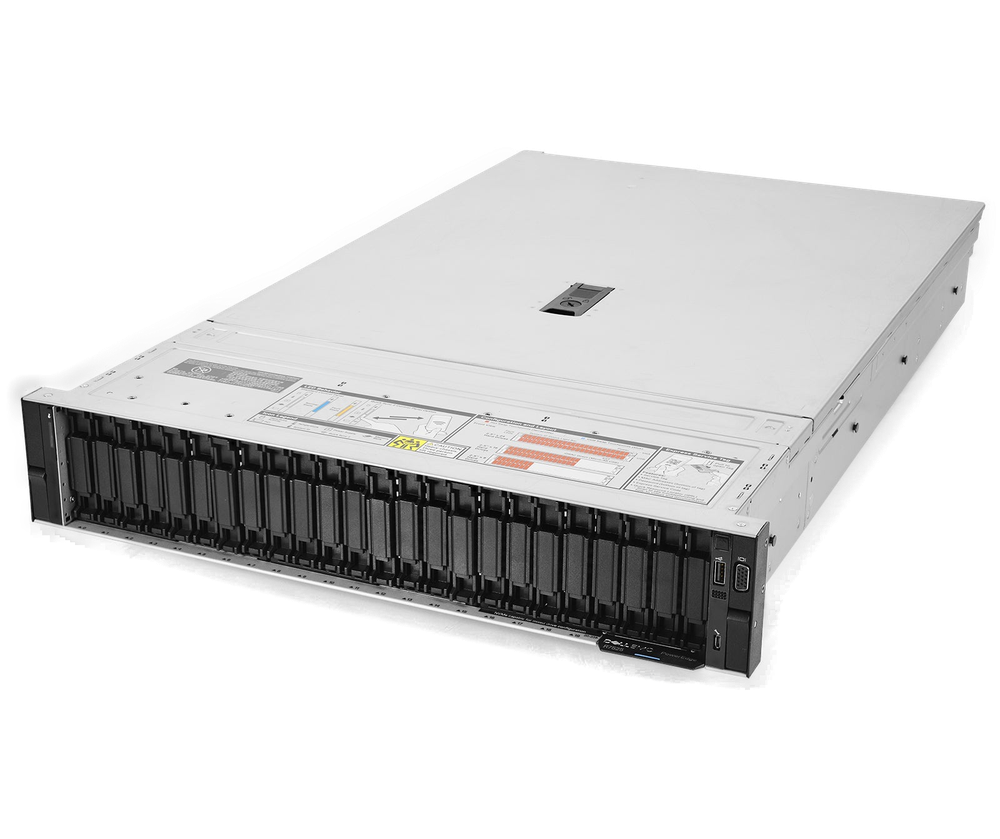
The Dell PowerEdge R750 is a 2U, 15th Gen (15G), dual-socket (LGA4189), Intel-based rack server. The R750’s motherboard supports 2x Intel 3rd Generation Scalable processors (Ice Lake – based on Intel’s Sunny Cove architecture) with a maximum TDP of 270W per CPU, maximum processor speed of 3.60Ghz, and a maximum of 40x physical cores per CPU – 80x cores total for the system. The system-board supports 16x DIMMs per processor for a total of 32x DIMMs and 8.2TB’s of PC4 / DDR4 ECC-Registered memory running at a max speed of 3200 Mhz. Depending on the chassis and configuration, this beast can weigh up to 78Lbs fully configured.
Select a Dell PowerEdge R750


Small Note: The PowerEdge and VxRail versions are identical, except for the customized firmware in the VxRail options. In addition, the VxRail P670F is the only chassis in this bunch that supports a flex-bay. The PowerEdge chassis includes a 16-bay SAS/SATA + 8-bay NVMe option. The only advantage of the 8-bay NVMe vs. the Universal bay configuration would be if you’re planning to use hardware RAID on those NVMe storage bays.
Enter the highest-end hybrid options with up to 8x Universal slots.
If you’re wondering what happened to the 12 + 12 hybrid options that were so popular with this Family’s predecessor (the R740xd’s) . . . so are we.
As with the 4-bay Universal drive options, flex-zoning would not be available here because the 8 Universal bays are set up for NVMe-direct.
Hey. At least you won’t be slowing down those speedy roadsters.
Maximum storage is over 1.2 PB with these dynamos, so we’ll skip the flex-bay option, which is only available with the VxRail P670F.
If you’re planning to scale over time and want to maintain as much flexibility as possible, these are among the best options to consider.
TechMike’s recommended applications (in addition to cloud virtualization):
Machine learning
Database
Website Hosting.
Media
Testing.
- Processor
- 2x 3rd Gen Intel Xeon Scalable (Ice Lake), LGA4189, up to 270W
- Max Cores
- 80 (40 per CPU)
 View all Processor specs
- Memory
- 32 DIMMs, up to 8.2 TB DDR4-3200 ECC RDIMM
- Max Storage
- 3 PB+ (all-NVMe chassis)
- Drive Bays
- SFF or LFF · SAS, SATA, NVMe, Universal · optional rear flex-bay
- Networking
- Embedded 2x 1GbE RJ-45 + OCP 3.0 slot
- Expansion
- Up to 8x PCIe 4.0 slots (6x x16)
- Power Supply
- 2x hot-swap redundant, up to 2,700 W
- Form Factor
- 2U rack · Up to 78 lbs
Model overview
The Dell PE R750 chassis supports hot-swap redundant power supplies with max wattage up to 2,700 Watts so if you’re considering adding some GPUs, you’ll definitely want to look at this bad boy as an option, just make sure you check riser and connector requirements – and if you don’t feel like going through that trouble, just visit our CTO here because we’ve already done that work for you (small note: you would have to select a GPU we currently have in stock). Max storage capacity can exceed 3PB’s (yes, petabytes!) on the all-NVMe version of the chassis. The Dell PowerEdge R750 chassis is available in various drive configurations supporting all types of SFF and LFF drives – SATA, SAS, NVMe, as well as hybrid options. Most versions also support a rear flex-bay, which could add either 2x 2.5’’ / SFF SAS / SATA drives, or, if you want to go crazy, 4x 2.5’’ Universal (NVMe / SAS / SATA) drives. Versatility is really what Dell was going for here so the options and combinations available really are wide-ranging and full-encompassing.
The Dell PowerEdge R750 server comes with an embedded dual-port 1GB RJ-45 network connection plus an optional LOM / NDC slot that accommodates an OCP 3.0 LOM mezzanine card (supporting PCIe 4.0 x16, as well as backward-compatible PCIe 5.0 options). Depending on the riser configuration, the R750 server could take up to 8x PCIe 4.0 x16 (Gen 4) NIC slots (6x of which are x16 – 16x lanes – slots), so if you’re still thinking about those GPUs, you’re covered.
GPU support
- Up to 4x x16 single-width, full-height full-length (FHFL) 150W GPUs
- Up to 4x single-width 6x8 (meaning a GPU with dual PCIe connectors, 1x 6-Pin PEG connector and 1x 8-Pin PEX connector), full-height full-length (FHFL) 75W GPUs
- Up to 6x single-width half-height half-length (HHHL) or full-height half length (FHHL) 75W GPUs
- Up to 2x double-width, full-height full-length (FHFL) 300W GPUs
Key features
- Universal drives support (versatile backplanes that’ll accommodate NVMe, SAS or SATA drives, or a combination of these for those of you who would like to stay 100% flexible as you scale your setup)
- Hybrid SAS + NVMe or SAS + Universal drive configurations
- Support for both Boss-S2 (gives you the 2x M.2 SATA SSDs without sacrificing a NIC slot) and Boss-S1 cards with up to 2x M.2 SATA SSDs
- Quick Sync 2.0 setup / scalability features
- 15 Gen DRAC 9 Dell remote access capabilities
Recommended uses
- General data center standardization
- Virtualization and cloud applications
- Virtual desktop infrastructure (VDI)
- Database and analytics
- High-performance computing
- Software-defined storage buildout
Configured servers
Build your own configurationLoading server comparison data...
Explore related models
- Previous generation
- Dell PowerEdge R740
- Next generation
- Dell PowerEdge R760
- Equivalent models
- HP ProLiant DL380 G10 Plus
Documentation
Manuals and technical guides for the selected chassis.
- Dell VxRail P670F, P670N, V670F, and S670 Technical Specifications
Dell VxRail P670F, P670N, V670F, and S670 are compact hyperconverged infrastructure appliances engineered by Dell Technologies for data centers requiring dense compute and streamlined virtualization. Each model supports dual third-generation Intel Xeon Scalable processors featuring up to forty cores per socket, paired with memory architectures that scale from 128 gigabytes to eight terabytes using RDIMM, LRDIMM, or Intel Persistent Memory modules running at 3200 MT/s. The chassis maintains a compact form factor measuring approximately four hundred eighty-two by seven hundred thirty-six by eighty-six point eight millimeters and weighs up to thirty-five point three kilograms, allowing deployment in standard server racks while accommodating up to six high-performance silver or gold cooling fans that dynamically adjust to CPU thermal design power ratings.
Storage flexibility defines the Dell VxRail P670F, P670N, V670F, and S670 lineup, with configurations spanning SAS, SATA, and all-NVMe drive options across front and rear bays. The P670F and V670F utilize twenty-four 2.5-inch front drives with optional universal slots or rear capacity modules, the P670N ships exclusively with twenty-four 2.5-inch NVMe drives for VMware vSAN OSA and ESA deployments, and the S670 combines twelve 3.5-inch front drives with four 2.5-inch rear drives. Internal storage controllers include BOSS-S1 and BOSS-S2 M.2 RAID arrays, HBA355i host bus adapters, and PERC H755 cards, while PCIe fourth-generation riser configurations provide versatile x8 and x16 expansion slots for GPUs and accelerator cards. Networking capabilities feature dual 1 Gigabit LAN on motherboard ports, optional OCP 3.0 interfaces supporting up to one hundred Gigabit speeds, USB connectors, Micro-USB iDRAC Direct management access, and standard VGA outputs.
Power delivery across the Dell VxRail P670F, P670N, V670F, and S670 relies on redundant AC power supplies ranging from one thousand one hundred to two thousand four hundred watts with Titanium or Platinum efficiency certifications, ensuring uninterrupted operation during peak workloads. Security and lifecycle management are handled through integrated iDRAC Direct functionality, comprehensive thermal restriction matrices that maintain stability across varying ambient temperatures, and strict environmental compliance for particulate filtration and gaseous contamination. These appliances directly address the needs of infrastructure architects and VMware administrators deploying private cloud platforms, virtual desktop environments, high-performance database systems, and analytics workloads that demand automated lifecycle management, rapid scaling, and consolidated hardware management without sacrificing performance or reliability.
Updated: October 1, 2026Download - Dell VxRail Solution Brief
Dell VxRail, manufactured by Dell Technologies alongside VMware, is the only fully integrated hyperconverged infrastructure platform engineered specifically for VMware vSAN and Cloud Foundation. Built on Dell PowerEdge hardware, the system spans form factors from the rugged VD-4000 and single-node satellite units to two-node edge clusters, three-node core arrays, and standard four or eight-node rack deployments. Each node leverages fourth-generation Intel Xeon Scalable processors or AMD EPYC chips to deliver scalable compute density across diverse architectural configurations.
Intelligent lifecycle management automates full-stack patching, upgrades, and non-disruptive scaling while maintaining a continuously validated cluster state. Storage architecture relies on NVMe caching and all-flash drives that utilize compression, deduplication, and erasure coding to maximize throughput. Compute nodes integrate VMware HCI Mesh and external storage arrays, supporting dynamic capacity expansion within a predictable pay-as-you-grow framework. Cloud-based orchestration tools apply artificial intelligence to monitor health metrics, optimize performance, and deliver centralized multi-cluster analytics.
Administration centers on native VxRail Manager and vCenter Server integration, allowing complete infrastructure control through a single familiar console. Security foundations include automated hardening scripts, FIPS 140-2 cryptography, and full DISA STIG compliance support. Data resilience features span in-transit and data-at-rest encryption, replication, backup utilities, and two-factor authentication via SecurID or CAC protocols. Key management operates through KMIP compatible managers to simplify enterprise compliance requirements.
Enterprises adopting VxRail target accelerated modernization, hybrid cloud expansion, and Kubernetes development while requiring simplified operations and reduced IT overhead. The platform supports graphics-heavy VDI, artificial intelligence workloads, high performance computing, and remote edge deployments. By eliminating multi-vendor friction and unifying hardware automation with VMware ecosystems, Dell VxRail helps buyers achieve up to a sixty-one percent reduction in five-year operational costs and a sixty-eight percent decrease in unplanned downtime through fully turnkey, secure infrastructure delivery.
Updated: October 1, 2026Download - Dell VxRail Spec Sheet
Dell VxRail, the hyperconverged infrastructure system manufactured by Dell Technologies, delivers a fully integrated VMware environment through platforms like the E660, E665, P670, P675, V670, S670, G560, and D560 models. Designed to extend existing virtualization deployments, this architecture scales non-disruptively from two to sixty-four nodes and utilizes intelligent lifecycle management to automate patches, upgrades, and node additions while maintaining a continuously validated state. The solution accommodates dynamic compute-only clusters for independent scaling and single-node satellite deployments for distributed edge sites, all built upon Dell PowerEdge server foundations. System configurations span one-unit rack mounts for space-constrained branches, ruggedized short-depth enclosures for extreme industrial conditions, and dense four-processor chassis, driven by Intel Xeon Scalable Gen 2 or Gen 3 processors alongside AMD EPYC Gen 2 or Gen 3 silicon with core counts reaching sixty-four per processor and up to two hundred twenty-four cores total.
Technical specifications across the E, P, V, S, G, and D series deliver substantial computational power and storage flexibility, with memory capacity ranging from sixty-four gigabytes to six terabytes per node. Storage architectures support all-NVMe, hybrid, and SAS or SATA configurations, delivering up to three hundred twenty-two terabytes of usable capacity while incorporating Intel Optane persistent memory for accelerated caching. Network expansion capabilities accommodate dual or quad ten-gigabit, twenty-five-gigabit, or two hundred-gigabit interfaces, alongside optional thirty-two-gigabit fibre channel HBAs installed via PCIe expansion slots, and multiple NVIDIA Tesla T4, A2, or A100 GPU ports for graphics-intensive workloads. Redundancy is engineered throughout the design, featuring SATA M.2 RAID one boot drives, high-efficiency power supplies, and multi-path networking that collectively ensure ninety-nine point nine nine nine percent system availability.
Dell VxRail simplifies infrastructure management through native integration with VMware vCenter and VMware Cloud Foundation SDDC Manager, granting administrators centralized automation and machine learning-driven health reporting without additional software costs. Enterprise-grade security and data protection are addressed via included RecoverPoint for VMs licenses, optional Data Domain Virtual Edition subscriptions, and Dell Secure Remote Services for proactive call-home monitoring and remote diagnostics. IT leaders target this solution for scaling mission-critical databases like SAP HANA, high-performance computing clusters, virtual desktop infrastructure, financial services applications, and retail edge locations requiring rapid data processing. By offering a predictable pay-as-you-grow model with automated lifecycle orchestration, the Dell VxRail platform directly satisfies buyer demands for operational consistency, rapid deployment, and highly reliable hyperconverged scaling across core data centers and distributed networks.
Updated: October 1, 2026Download - iDRAC 9 User's Guide
Dell Integrated Remote Access Controller 9 (iDRAC 9) serves as an out-of-band server management platform that allows IT administrators to remotely deploy, monitor, and troubleshoot infrastructure without relying on host operating systems or installed agents. This controller continuously tracks performance metrics across processor core counts, memory capacity allocations, and PCIe expansion slot utilization while mapping storage options and chassis form factors for rack, tower, and blade deployments. By aggregating these hardware telemetry streams into a composite CUPS index, the platform helps operations teams detect compute bottlenecks or thermal anomalies before they trigger service interruptions.
Security and access control define the operational scope of iDRAC 9, with feature progression across Basic, Express, Enterprise, and Datacenter licensing tiers. The architecture enforces strict authentication through Active Directory, LDAP, smart card validation, multi-factor codes, and role-based privilege levels, alongside FIPS 140-2 compliance and mandatory TLS encryption for all management traffic. Network teams can harden deployments using IP blocking, configurable password strength policies, and dedicated management subnets, while programmatic automation remains accessible through RACADM CLI, Redfish API, WSMan, SSH, and IPMI protocols. Zero-touch provisioning further accelerates bare-metal scaling by automatically delivering Server Configuration Profiles via DHCP options over NFS or HTTP shares.
Beyond identity and network hardening, Dell iDRAC 9 provides comprehensive storage subsystem control, enabling buyers to configure virtual disks across PERC controllers with RAID levels spanning zero through sixty, adjust cache policies, monitor drive wear endurance, and execute cryptographic erasure on SED drives. The management suite includes virtual media mounting, embedded vConsole KVM access, telemetry streaming, and automated firmware lifecycle procedures that support staged updates, rollback mechanisms, and SD-card recovery during catastrophic failures. Ultimately, this solution targets data center operations groups seeking to minimize downtime, enforce regulatory compliance, automate infrastructure scaling, and optimize energy efficiency through power capping and dynamic thermal profile adjustments across large-scale server fleets.
Updated: October 1, 2026Download - Dell Host Bus Adapter (HBA355, HBA350) User's Guide
The Dell Technologies Host Bus Adapter series, specifically the HBA355i Adapter, HBA355i Front, HBA355e Adapter, HBA350i MX, and HBA350i Adapter, provides enterprise-grade non-RAID storage connectivity for PowerEdge server infrastructure. These PCIe Gen 4 x8 host interface cards are built around LSI Fusion-MPT controllers, utilizing the SAS3816 or SAS3808 silicon to manage data traffic efficiently. While they lack traditional system memory, they incorporate substantial queue depths ranging from 7552 to 8320 entries to handle concurrent I/O requests. The form factors cater to diverse chassis layouts, offering standard rear-mounted adapters, front-facing carrier designs, external multi-port controllers, and modular MX sled variants. Storage capacity scales according to the selected model, with the HBA355i variants supporting up to sixteen internal SAS or SATA drives per controller, while the HBA350i models are optimized for eight-drive direct connections. The external HBA355e Adapter expands beyond internal bays to support dual-path configurations with MD1400, MD1420, and ME484 JBOD enclosures, as well as LTO 6 through 8 tape drives for archival workflows.
Security and operational reliability are enforced through a Hardware Root of Trust that authenticates all firmware components before execution, ensuring only verified code runs on the controllers. Management is streamlined across the IT lifecycle via the pre-boot Human Interface Infrastructure utility, Dell OpenManage Storage Management, and full integration with Integrated Dell Remote Access Controller and Lifecycle Controller tools. Administrators can update firmware through Dell Update Packages or command-line interfaces, with robust driver support spanning Windows Server 2016 and later, Red Hat Enterprise Linux, SUSE Linux, and VMware ESXi. Multipath I/O capabilities are thoroughly documented for both Windows and Linux environments, allowing redundant data paths to balance load and maintain continuous access to physical disks without OS-level intervention.
These Dell Technologies Host Bus Adapter models directly address the needs of system architects and data center professionals seeking high-performance direct-attached storage expansion without software RAID overhead. They enable seamless integration into existing PowerEdge R-series, T-series, and MX deployments, making them ideal for virtualization hosts, hyperconverged infrastructure nodes, and large-scale backup or cold-storage environments. Buyers relying on the Dell HBA355i Adapter, HBA355e Adapter, and related models gain a flexible, secure, and highly manageable foundation for scaling raw disk capacity while maintaining enterprise-grade fault tolerance and simplified hardware lifecycle control.
Updated: October 1, 2026Download
Still have questions?
We’re here to help. Tell us what you’re building and we’ll help you configure a Dell PowerEdge R750 that fits your rack and your budget.
Send us a message
A real engineer reads every one of these messages and will get back to you within 24 hours.