

Dell PowerEdge R750
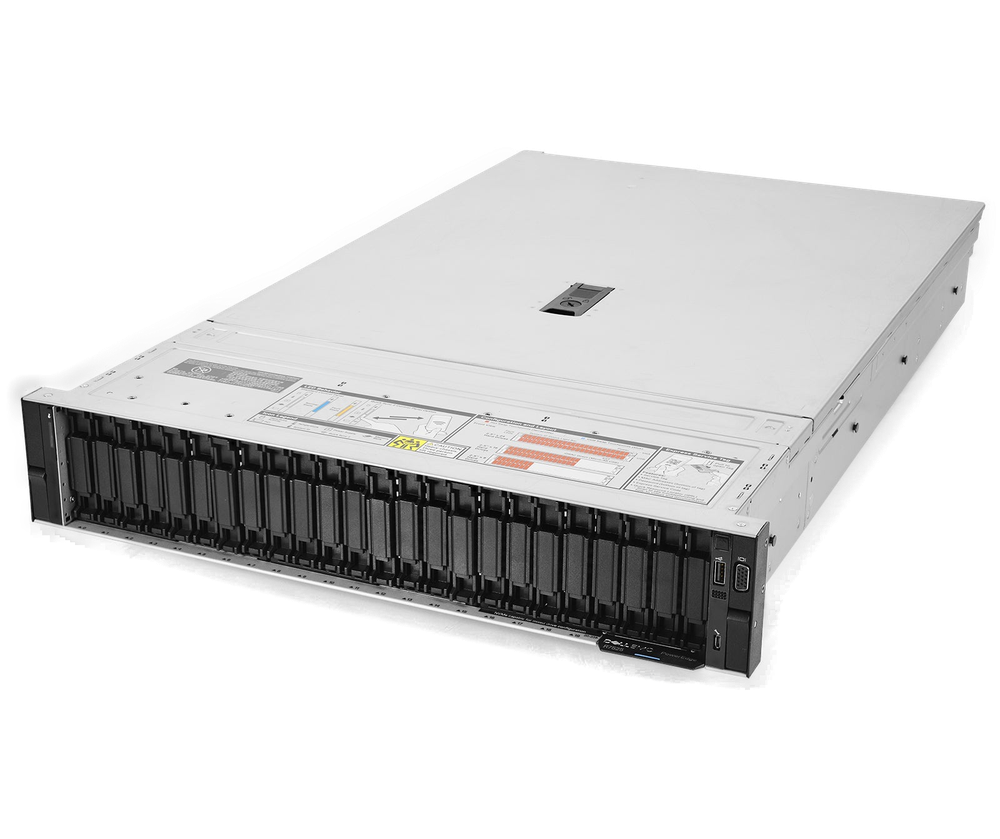
The Dell PowerEdge R750 is a 2U, 15th Gen (15G), dual-socket (LGA4189), Intel-based rack server. The R750’s motherboard supports 2x Intel 3rd Generation Scalable processors (Ice Lake – based on Intel’s Sunny Cove architecture) with a maximum TDP of 270W per CPU, maximum processor speed of 3.60Ghz, and a maximum of 40x physical cores per CPU – 80x cores total for the system. The system-board supports 16x DIMMs per processor for a total of 32x DIMMs and 8.2TB’s of PC4 / DDR4 ECC-Registered memory running at a max speed of 3200 Mhz. Depending on the chassis and configuration, this beast can weigh up to 78Lbs fully configured.
Select a Dell PowerEdge R750


Small note: the PowerEdge and VxRail versions are identical but for the customized firmware on the VxRail options. In addition, the VxRail P670F is the only chassis that supports a flex-bay out of this bunch and the PowerEdge chassis also includes a 16-bay SAS / SATA + 8-bay NVMe option. The only advantage to the 8-bay NVMe vs. Universal bay configuration would be if you’re planning to hardware-RAID those NVMe storage bays.
Enter the highest-end hybrid options with up to 8x Universal slots. If you’re wondering what happened to the 12 + 12 hybrid options that were so popular with this Family’s predecessor (the R740xd’s), so are we.
As is the case with the 4-bay Universal drive options we’ve discussed, flex-zoning would also not be possible with these chassis since the 8x Universal bays are also set up for NVMe-direct. Hey, at least you wouldn’t be slowing down those speedy roadsters.
Max storage is over 1.2PBs with these dynamos so we’ll skip the flex-bay option, which is really only available with the VxRail P670F.
If you’re planning to scale over time and would like to keep the flexibility, these really would be the best options to consider out of the bunch.
TechMike’s recommended applications include:
Machine Learning
Database
Website Hosting
Media
Testing
- Processor
- 2x 3rd Gen Intel Xeon Scalable (Ice Lake), LGA4189, up to 270W
- Max Cores
- 80 (40 per CPU)
 View all Processor specs
- Memory
- 32 DIMMs, up to 8.2 TB DDR4-3200 ECC RDIMM
- Max Storage
- 3 PB+ (all-NVMe chassis)
- Drive Bays
- SFF or LFF · SAS, SATA, NVMe, Universal · optional rear flex-bay
- Networking
- Embedded 2x 1GbE RJ-45 + OCP 3.0 slot
- Expansion
- Up to 8x PCIe 4.0 slots (6x x16)
- Power Supply
- 2x hot-swap redundant, up to 2,700 W
- Form Factor
- 2U rack · Up to 78 lbs
Model overview
The Dell PE R750 chassis supports hot-swap redundant power supplies with max wattage up to 2,700 Watts so if you’re considering adding some GPUs, you’ll definitely want to look at this bad boy as an option, just make sure you check riser and connector requirements – and if you don’t feel like going through that trouble, just visit our CTO here because we’ve already done that work for you (small note: you would have to select a GPU we currently have in stock). Max storage capacity can exceed 3PB’s (yes, petabytes!) on the all-NVMe version of the chassis. The Dell PowerEdge R750 chassis is available in various drive configurations supporting all types of SFF and LFF drives – SATA, SAS, NVMe, as well as hybrid options. Most versions also support a rear flex-bay, which could add either 2x 2.5’’ / SFF SAS / SATA drives, or, if you want to go crazy, 4x 2.5’’ Universal (NVMe / SAS / SATA) drives. Versatility is really what Dell was going for here so the options and combinations available really are wide-ranging and full-encompassing.
The Dell PowerEdge R750 server comes with an embedded dual-port 1GB RJ-45 network connection plus an optional LOM / NDC slot that accommodates an OCP 3.0 LOM mezzanine card (supporting PCIe 4.0 x16, as well as backward-compatible PCIe 5.0 options). Depending on the riser configuration, the R750 server could take up to 8x PCIe 4.0 x16 (Gen 4) NIC slots (6x of which are x16 – 16x lanes – slots), so if you’re still thinking about those GPUs, you’re covered.
GPU support
- Up to 4x x16 single-width, full-height full-length (FHFL) 150W GPUs
- Up to 4x single-width 6x8 (meaning a GPU with dual PCIe connectors, 1x 6-Pin PEG connector and 1x 8-Pin PEX connector), full-height full-length (FHFL) 75W GPUs
- Up to 6x single-width half-height half-length (HHHL) or full-height half length (FHHL) 75W GPUs
- Up to 2x double-width, full-height full-length (FHFL) 300W GPUs
Key features
- Universal drives support (versatile backplanes that’ll accommodate NVMe, SAS or SATA drives, or a combination of these for those of you who would like to stay 100% flexible as you scale your setup)
- Hybrid SAS + NVMe or SAS + Universal drive configurations
- Support for both Boss-S2 (gives you the 2x M.2 SATA SSDs without sacrificing a NIC slot) and Boss-S1 cards with up to 2x M.2 SATA SSDs
- Quick Sync 2.0 setup / scalability features
- 15 Gen DRAC 9 Dell remote access capabilities
Recommended uses
- General data center standardization
- Virtualization and cloud applications
- Virtual desktop infrastructure (VDI)
- Database and analytics
- High-performance computing
- Software-defined storage buildout
Configured servers
Build your own configurationLoading server comparison data...
Explore related models
- Previous generation
- Dell PowerEdge R740
- Next generation
- Dell PowerEdge R760
- Equivalent models
- HP ProLiant DL380 G10 Plus
Documentation
Manuals and technical guides for the selected chassis.
- iDRAC 9 User's Guide
Dell Integrated Remote Access Controller 9 (iDRAC 9) serves as an out-of-band server management platform that allows IT administrators to remotely deploy, monitor, and troubleshoot infrastructure without relying on host operating systems or installed agents. This controller continuously tracks performance metrics across processor core counts, memory capacity allocations, and PCIe expansion slot utilization while mapping storage options and chassis form factors for rack, tower, and blade deployments. By aggregating these hardware telemetry streams into a composite CUPS index, the platform helps operations teams detect compute bottlenecks or thermal anomalies before they trigger service interruptions.
Security and access control define the operational scope of iDRAC 9, with feature progression across Basic, Express, Enterprise, and Datacenter licensing tiers. The architecture enforces strict authentication through Active Directory, LDAP, smart card validation, multi-factor codes, and role-based privilege levels, alongside FIPS 140-2 compliance and mandatory TLS encryption for all management traffic. Network teams can harden deployments using IP blocking, configurable password strength policies, and dedicated management subnets, while programmatic automation remains accessible through RACADM CLI, Redfish API, WSMan, SSH, and IPMI protocols. Zero-touch provisioning further accelerates bare-metal scaling by automatically delivering Server Configuration Profiles via DHCP options over NFS or HTTP shares.
Beyond identity and network hardening, Dell iDRAC 9 provides comprehensive storage subsystem control, enabling buyers to configure virtual disks across PERC controllers with RAID levels spanning zero through sixty, adjust cache policies, monitor drive wear endurance, and execute cryptographic erasure on SED drives. The management suite includes virtual media mounting, embedded vConsole KVM access, telemetry streaming, and automated firmware lifecycle procedures that support staged updates, rollback mechanisms, and SD-card recovery during catastrophic failures. Ultimately, this solution targets data center operations groups seeking to minimize downtime, enforce regulatory compliance, automate infrastructure scaling, and optimize energy efficiency through power capping and dynamic thermal profile adjustments across large-scale server fleets.
Updated: October 1, 2026Download - Dell PowerEdge R750 Installation and Service Manual
The Dell PowerEdge R750 is a two-socket, rack-mounted enterprise server designed to deliver scalable processing power and flexible storage architecture for demanding data center environments. Built around Intel Xeon Scalable processors supporting high core counts across dual CPUs, the system accommodates up to twenty-eight DDR4 RDIMMs or LRDIMMs, with strict channel population rules to ensure optimal memory bandwidth. It also supports Intel Persistent Memory 200 series modules for enhanced capacity and throughput. Storage flexibility is a central feature, offering configurations for sixteen or twenty-four two point five inch drives in SAS, SATA, or NVMe layouts, managed by front-extracted PERC controllers, adapter PERC cards, BOSS S2 M.2 modules, or IDSDM hardware with MicroSD support. The server occupies a standard rack form factor within enterprise enclosures and requires precise drive backplane and riser matching to maintain signal integrity and power distribution.
Expansion capabilities are tightly engineered through four primary PCIe riser configurations that accommodate full-height and low-profile cards, including NVIDIA and Intel GPUs, Mellanox and Broadcom NICs, Emulex and QLogic HBAs, DPUs, and OCP adapters. High-performance workloads demand power supplies rated up to one thousand eight hundred watts in redundant setups, alongside dedicated GPU air shrouds and thermal routing protocols. The Dell PowerEdge R750 integrates comprehensive remote management through iDRAC, enabling out-of-band provisioning, firmware updates, and real-time hardware monitoring via Quick Sync and Direct interfaces. Thermal reliability is enforced through mandatory fan blanks, filler brackets for FCC compliance, and optional liquid cooling systems that require certified leak-detection cable installation. System memory, processor torque specifications of twelve inch-pounds, and anti-tilt wire positioning ensure stable long-term operation under heavy computational loads.
Security and lifecycle management are addressed through cryptographic TPM modules permanently bound to the motherboard at installation, alongside embedded system diagnostics accessible via the Lifecycle Controller or Boot Manager. Forgotten passwords can be recovered using dedicated jumper sequences, while Dell SupportAssist automates fault detection and ticket generation for uninterrupted operations. IT administrators and certified technicians rely on the Dell PowerEdge R750 for virtualization platforms, AI inference tasks, high-performance computing, and dense storage applications that require rapid hardware validation, component swapping, and centralized deployment workflows. The server explicitly mandates Dell-validated expansion cards to preserve warranty coverage and prevent thermal or electrical damage, ensuring that enterprise buyers receive a predictable, compliant infrastructure foundation tailored for scalable, mission-critical data processing.
Updated: October 1, 2026Download - Dell PowerEdge R750 Technical Specifications
The Dell EMC PowerEdge R750 is a highly versatile 2U rack server engineered by Dell to deliver enterprise-grade performance and flexibility for demanding data center environments. Built to accommodate dual third-generation Intel Xeon Scalable processors, each chip supports up to forty cores, providing robust multi-threaded processing power for virtualization, database workloads, and heavy computing tasks. Memory subsystems are equally expansive, featuring thirty-two 3200 MT/s DDR4 DIMM sockets that support registered and load-reduced inline memory modules alongside Intel Persistent Memory BPS configurations. Depending on the selected components, administrators can scale total memory capacity from a few gigabytes up to four terabytes across dual-processor setups, ensuring optimal resource allocation for memory-intensive applications.
Storage and expansion capabilities are tightly integrated into the Dell EMC PowerEdge R750 architecture to support diverse deployment scenarios. The chassis accommodates flexible drive configurations ranging from bare backplanes to twenty-four hot-swappable 2.5-inch NVMe or SAS drives, alongside twelve 3.5-inch SAS or SATA bays, all manageable through PERC H745, H755, or external controllers like the H840. Expansion is handled via up to eight low-profile or six full-height PCIe Gen 4 riser slots, enabling the integration of high-throughput network adapters and professional GPUs such as the NVIDIA A100 or T4 for artificial intelligence workloads. Power delivery utilizes redundant AC or DC power supply units rated from seven hundred to two thousand eight hundred watts, boasting Titanium or Platinum efficiency certifications. Thermal management relies on standardized or high-performance silver and gold grade cooling fans, with optional processor liquid cooling available for sustained extreme loads in ASHRAE compliant facilities.
Operational control and security are prioritized through the Dell EMC PowerEdge R750 integrated management suite, which includes iDRAC Direct access via a dedicated micro USB port and an optional Internal Dual SD module for boot redundancy or lightweight operating system deployment. Network connectivity is bolstered by embedded 1 GbE LAN-on-motherboard ports alongside OCP 3.0 cards supporting speeds up to 25 Gbps, while physical security and remote diagnostics are facilitated through VGA output and serial console options. This server explicitly targets infrastructure managers and enterprise buyers who require scalable compute density, resilient uptime, and strict adherence to environmental contamination and power efficiency standards. By combining processor flexibility, extensive memory pathways, rapid NVMe storage tiers, and comprehensive remote administration tools, the Dell EMC PowerEdge R750 serves as a foundational platform for modernizing hybrid cloud infrastructure, high-performance computing clusters, and secure enterprise data centers.
Updated: October 1, 2026Download - Dell PowerEdge R750 Technical Guide
Manufactured by Dell Technologies, the Dell EMC PowerEdge R750 is a versatile two-socket, 2U rack-mount server designed to deliver robust performance for demanding enterprise environments. Built around Intel third-generation Xeon Scalable processors, the platform supports dual CPUs with up to forty high-performance cores per socket and thirty-two DDR4 memory slots that operate at speeds reaching 3200 MT/s. Buyers requiring extensive data processing capabilities can leverage up to 12 TB of system memory by combining registered DIMMs with Intel Optane persistent memory modules, ensuring low-latency access for critical applications while maintaining high throughput across both processor sockets.
Storage and expansion flexibility define the architecture of the Dell EMC PowerEdge R750, which accommodates a wide array of SAS, SATA, and NVMe drives in 2.5-inch and 3.5-inch form factors across multiple internal backplane configurations. The system eliminates traditional PCIe slot consumption for RAID operations through embedded fPERC technology, while offering up to eight dedicated PCI Express generation four expansion slots that can be routed via various riser options to support GPUs or specialized network adapters. Networking capabilities are enhanced by onboard OCP NIC 3.0 interfaces paired with SNAP input-output technology to balance bandwidth across both processors and prevent network bottlenecks. Power delivery is handled by hot-plug Platinum and Titanium efficiency power supplies ranging from 700W to 2800W, ensuring continuous operation and dynamic power capping within dense data center racks.
Administrators rely on the integrated management suite of the Dell EMC PowerEdge R750 to streamline deployment, monitoring, and security across heterogeneous infrastructure. The platform ships with Integrated Dell Remote Access Controller Enterprise hardware, enabling out-of-band server control, automated firmware updates through the OpenManage Enterprise console, and predictive fault detection via SupportAssist analytics. Security requirements are met with Trusted Platform Module compliance, UEFI secure boot protocols, and comprehensive integration with industry-standard automation frameworks like Ansible and Redfish APIs. Organizations targeting general data center consolidation, high-density virtualization, cloud-native application hosting, in-memory databases, and high-performance computing clusters find the Dell EMC PowerEdge R750 uniquely equipped to consolidate hardware footprints while delivering the scalability, reliability, and proactive maintenance tools necessary for modern enterprise IT operations.
Updated: October 1, 2026Download - Dell PowerEdge R750 Spec Sheet
The Dell PowerEdge R750 is a 2U rack server from Dell Technologies engineered for demanding enterprise workloads. Built around dual sockets for up to two third-generation Intel Xeon Scalable processors with forty cores each, the system supports thirty-two DDR4 DIMM slots handling RDIMM memory up to two terabytes or LRDIMM configurations reaching eight terabytes at three thousand two hundred megatransfers per second. Storage flexibility is extensive, accommodating up to twenty-four NVMe drives alongside mixed SAS and SATA bays that reach approximately three hundred sixty-eight terabytes of capacity. To satisfy intensive computational demands, the Dell PowerEdge R750 provides eight PCIe Gen 4 expansion slots capable of hosting multiple high-performance accelerators. This combination of dense processing, expansive memory, and high-speed I/O makes it a standard platform for virtual desktop infrastructure, database analytics, traditional corporate IT, and artificial intelligence environments where buyers require predictable scale and hardware flexibility.
Operational efficiency is driven by the integrated iDRAC9 module and the broader Dell EMC OpenManage portfolio, which deliver telemetry streaming, Redfish API access, and intelligent automation to eliminate configuration silos. IT leaders execute zero-touch provisioning while leveraging seamless integrations with VMware vCenter, Microsoft System Center, Ansible, and ServiceNow to accelerate deployment cycles. Thermal management accommodates heavy loads through hot-pluggable fans, with optional direct liquid cooling available for sustained high-power applications. Power options span seven hundred to twenty-eight hundred watts across AC and DC variants, ensuring compatibility with diverse data center architectures. Buyers gain a streamlined management ecosystem that reduces administrative overhead while maintaining strict uptime requirements.
Security compliance is deeply embedded into the Dell PowerEdge R750 lifecycle to protect sensitive enterprise assets from design through retirement. The platform utilizes cryptographically trusted boot processes anchored by a silicon root of trust, guaranteeing that only verified firmware executes during startup. Administrators prevent unauthorized modifications through system lockdown capabilities, validate updates using digitally signed firmware packages, and execute secure erases on drives or system memory before decommissioning. Certified TPM modules further shield data against emerging threats, addressing the critical protection needs of regulated industries. Organizations adopting this architecture achieve a cyber-resilient foundation that balances rigorous security controls with the raw performance necessary to drive continuous business innovation.
Updated: October 1, 2026Download - Dell PowerEdge R750 BIOS and UEFI Reference Guide
The Dell EMC PowerEdge R750 is a dual-processor rack server designed by Dell that delivers scalable compute power for mission-critical enterprise workloads. Built on Intel Xeon Scalable processors, this model supports extensive core counts per socket with hyper-threading enabling up to two logical processors per core, while processor interconnect speed can be tuned via Ultra Path Interconnect links to balance performance and power consumption. The memory architecture accommodates high-capacity DDR4 DIMMs with configurable frequency targets, supporting Node Interleaving for symmetric configurations or Non-Uniform Memory Architecture for asymmetric layouts, and includes Adaptive Double DRAM Device Correction to mask failing DRAM modules. Additionally, the Dell EMC PowerEdge R750 supports Intel Persistent Memory technologies, providing storage-class memory options for latency-sensitive applications requiring large data pools.
Storage and expansion configurations in the Dell EMC PowerEdge R750 utilize embedded SATA and NVMe controllers with RAID capabilities accessible through UEFI boot modes. The system board features multiple PCIe slots supporting bifurcation for paddle cards and risers, allowing flexible adapter placement, while BOSS PCIe cards offer internal M.2 drives for dedicated boot media. An Internal Dual SD Module enables mirrored redundancy for operating system images, ensuring data integrity across storage interfaces. Networking integration includes embedded NICs with UEFI PXE and HTTP device support for remote deployment, alongside I/O Acceleration Technology to reduce CPU utilization during high-throughput traffic. The R750 model also incorporates slot disablement controls and Memory Mapped I/O above 4 GB to optimize resource distribution for large graphics accelerator or network interface card installations.
Security implementations in the Dell EMC PowerEdge R750 encompass Trusted Platform Module versions 1.2 and 2.0, UEFI Secure Boot with customizable policy modes, Intel Software Guard Extensions for isolated execution environments, and Intel Total Memory Encryption to protect data at rest. Administrators can enforce access restrictions using system passwords, setup locks, and the integrated Lifecycle Controller for automated firmware updates, while the out-of-band iDRAC interface provides comprehensive remote management and diagnostic tools. Redundant OS Control features allow the Dell EMC PowerEdge R750 to maintain backup operating systems on internal drives or SD media for rapid failover. With configurable Thermal Design Power levels and system profiles ranging from Maximum Performance to Power Per Watt efficiency, this server addresses diverse buyer needs for virtualization hosts, high-performance databases, and environmentally conscious cloud data centers requiring robust reliability and lifecycle management.
Updated: October 1, 2026Download - Dell PowerEdge R750 Statement of Volatility
The Dell EMC PowerEdge R750 server features a dual-socket architecture supporting up to sixteen DIMM slots per processor. It accommodates standard DDR4 alongside specialized tiers like System Memory-BPS, scaling to 512GB per module for application workloads, and NVDIMM options providing 16GB per slot for critical retention. Storage flexibility defines the Dell EMC PowerEdge R750, offering backplane configurations from dual rear drives to front layouts supporting eight, twelve, sixteen, or twenty-four bays for SAS, SATA, and NVMe media. Data integrity relies on internal PERC controllers including the H745, H755, H345, H840, and HBA355i adapters, each equipped with four to eight gigabytes of SDRAM cache and non-volatile flash to preserve operations during power interruptions.
Management within the Dell EMC PowerEdge R750 separates volatile data from persistent storage. The iDRAC subsystem uses DDR4 RAM for processing while BMC EMMC and SPI Flash permanently retain firmware, logs, and diagnostics. Hardware trust is enforced via a Trusted Platform Module, and IDSDM automates OS deployment through internal uSD cards. System parameters are safeguarded across numerous reference designators, with write protection actively managed at hardware and software levels for critical BIOS regions and power sequencing controllers.
Enterprise buyers deploy this platform when requiring a configurable rack-mount server that balances memory scaling with resilient storage. The volatility documentation helps administrators precisely plan updates and replacements by distinguishing persistent flash from temporary RAM across processors and cache channels. This architecture supports mission-critical database operations, virtualized cloud workloads, and high-performance computing environments that demand reliable uptime and granular administrative control.
Updated: October 1, 2026Download - Dell PowerEdge RAID Controller 11 (PERC H755, H750, H355, H350) User's Guide
Dell PowerEdge RAID Controller 11 series adapters, specifically the H755, H750, H355, and H350 models manufactured by Dell, deliver enterprise storage infrastructure for modern server deployments. These PCIe expansion slot interface cards operate over SAS 3.0 at twelve gigabits per second and support up to eight gigabytes of DDR4 write-back cache paired with either a battery backup unit or non-volatile memory module. Hardware variants span riser adapter cards, front-mounted SAS and NVMe configurations, MX sleds, and Mini Monolithic form factors to match diverse chassis backplanes. The flagship H755 model enables native PCIe Gen4 connectivity alongside comprehensive RAID 0, 1, 5, 6, 10, 50, and 60 support, whereas the H350 and H355 variants restrict operations to RAID 0, 1, and 10 without NVMe compatibility or advanced cache encryption.
IT administrators configure and monitor these Dell PowerEdge RAID Controller 11 adapters through four integrated management pathways: a BIOS-integrated Human Interface Infrastructure utility, the PERC command-line interface, Dell OpenManage Storage Management, and out-of-band monitoring via iDRAC firmware. Operational workflows feature online capacity expansion, RAID level migration, virtual disk relocation between physical adapters, and automated background initialization paired with proactive patrol read health checks. The architecture handles hot-swap drive replacement using dedicated or global spare pools, automatically triggering accelerated rebuilds while maintaining continuous uptime during routine maintenance windows. Non-volatile cache preservation guarantees zero data loss during power interruptions by retaining pending writes until system recovery completes.
Compliance and protection requirements are satisfied through hardware-level encryption capabilities including full Opal and TCG standards for self-encrypting drives, instantaneous secure erasure functions, and cryptographic wiping protocols. Key distribution scales from localized storage to centralized enterprise deployment via Dell OpenManage Secure Enterprise Key Manager across distributed data centers. A verified hardware root of trust authenticates all firmware components before execution to prevent unauthorized code injection. Procurement teams select the Dell PowerEdge RAID Controller 11 lineup, particularly the H755 and H350 models from Dell, to consolidate storage provisioning, accelerate virtual machine and database workloads, and enforce strict governance policies across Windows Server, RHEL, SUSE Linux, and VMware ESXi environments without sacrificing administrative efficiency or throughput.
Updated: October 1, 2026Download - Dell Host Bus Adapter (HBA355, HBA350) User's Guide
The Dell Technologies Host Bus Adapter series, specifically the HBA355i Adapter, HBA355i Front, HBA355e Adapter, HBA350i MX, and HBA350i Adapter, provides enterprise-grade non-RAID storage connectivity for PowerEdge server infrastructure. These PCIe Gen 4 x8 host interface cards are built around LSI Fusion-MPT controllers, utilizing the SAS3816 or SAS3808 silicon to manage data traffic efficiently. While they lack traditional system memory, they incorporate substantial queue depths ranging from 7552 to 8320 entries to handle concurrent I/O requests. The form factors cater to diverse chassis layouts, offering standard rear-mounted adapters, front-facing carrier designs, external multi-port controllers, and modular MX sled variants. Storage capacity scales according to the selected model, with the HBA355i variants supporting up to sixteen internal SAS or SATA drives per controller, while the HBA350i models are optimized for eight-drive direct connections. The external HBA355e Adapter expands beyond internal bays to support dual-path configurations with MD1400, MD1420, and ME484 JBOD enclosures, as well as LTO 6 through 8 tape drives for archival workflows.
Security and operational reliability are enforced through a Hardware Root of Trust that authenticates all firmware components before execution, ensuring only verified code runs on the controllers. Management is streamlined across the IT lifecycle via the pre-boot Human Interface Infrastructure utility, Dell OpenManage Storage Management, and full integration with Integrated Dell Remote Access Controller and Lifecycle Controller tools. Administrators can update firmware through Dell Update Packages or command-line interfaces, with robust driver support spanning Windows Server 2016 and later, Red Hat Enterprise Linux, SUSE Linux, and VMware ESXi. Multipath I/O capabilities are thoroughly documented for both Windows and Linux environments, allowing redundant data paths to balance load and maintain continuous access to physical disks without OS-level intervention.
These Dell Technologies Host Bus Adapter models directly address the needs of system architects and data center professionals seeking high-performance direct-attached storage expansion without software RAID overhead. They enable seamless integration into existing PowerEdge R-series, T-series, and MX deployments, making them ideal for virtualization hosts, hyperconverged infrastructure nodes, and large-scale backup or cold-storage environments. Buyers relying on the Dell HBA355i Adapter, HBA355e Adapter, and related models gain a flexible, secure, and highly manageable foundation for scaling raw disk capacity while maintaining enterprise-grade fault tolerance and simplified hardware lifecycle control.
Updated: October 1, 2026Download
Still have questions?
We’re here to help. Tell us what you’re building and we’ll help you configure a Dell PowerEdge R750 that fits your rack and your budget.
Send us a message
A real engineer reads every one of these messages and will get back to you within 24 hours.