

Dell PowerEdge R7515
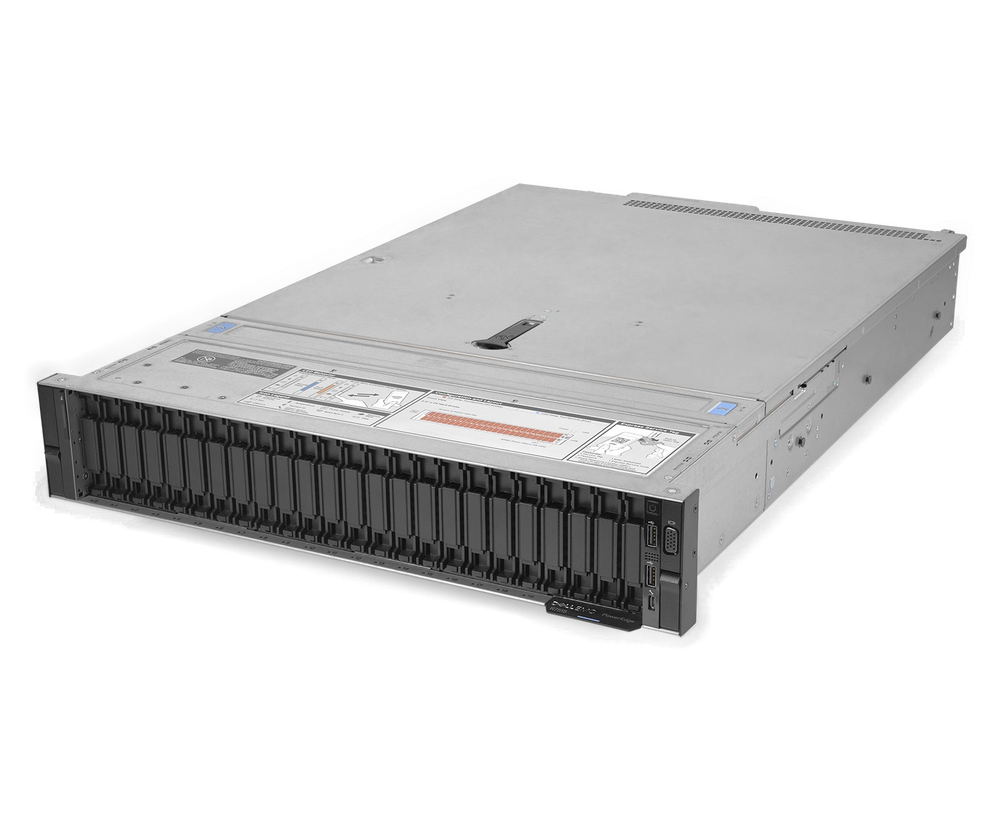
The Dell PowerEdge R7515 is a 2U, 15th Gen (15G), single-socket (SP3), AMD-based rack server. The R7515’s motherboard supports 1x AMD EPYC 2nd (Rome – based on AMD’s Zen 2 architecture) or 3rd generation (Milan – based on AMD’s Zen 3 architecture) processor with a maximum TDP of 280W, maximum processor speed of 3.70Ghz, and a maximum of 64x physical cores. The system-board supports 16x DIMMs for a total of 4.1TB’s of PC4 / DDR4 ECC-Registered memory running at a max speed of 3200 Mhz. Depending on the chassis and configuration, this baby can weigh up to 57Lbs fully configured.
Select a Dell PowerEdge R7515

Dell PowerEdge R7515 8-Bay NVMe SFF Rack-Mountable 2U Server Chassis
While just as light as the standard 8-bay chassis, this configuration is a pure NVMe option for those looking for a high-performing/low-latency monster without breaking the bank. With all NVMe drives, the maximum storage capacity gets fairly close to a petabyte.
This provides a good entry point to a 15th Gen 2U all-NVMe chassis, assuming you need the extra PCIe slots you wouldn’t get in a more affordable 1U chassis and/or need space for a double-width GPU. (If you plan to add one, keep in mind that the maximum wattage is 225W.)
TechMike’s recommended applications:
Media.
Website Hosting.
Database.
File Hosting.
Gaming.
If you’re simply looking for an entry into a 15 Gen AMD-based all-NVMe chassis and don’t need the additional PCIe slots, we’d honestly recommend checking out the PowerEdge R6515 option instead.
- Processor
- 1x 2nd/3rd Gen AMD EPYC (Rome/Milan), SP3, up to 280W
- Max Cores
- 64 (single CPU)
 View all Processor specs
- Memory
- 16 DIMMs, up to 4.1 TB DDR4-3200 ECC RDIMM
- Max Storage
- Up to 3 PB (all-NVMe chassis)
- Drive Bays
- SFF or LFF · SAS, SATA, NVMe · up to 24 SFF or 14 LFF
- Networking
- Embedded 2x 1GbE RJ-45 + OCP 2.0 slot
- Expansion
- Up to 4x PCIe slots (2x Gen 4 x16, 2x Gen 3 x16)
- Power Supply
- 2x hot-swap redundant, up to 1,600 W
- Form Factor
- 2U rack · Up to 57 lbs
Model overview
The Dell PowerEdge R7515 chassis supports hot-swap redundant power supplies with max wattage up to 1,600 Watts. Max storage capacity can reach 3PB’s on the all-NVMe version of the chassis. The Dell PowerEdge R7515 chassis is available in various drive configurations supporting all types of SFF and LFF drives – SATA, SAS, NVMe, as well as hybrid options. Only the 12-bay 3.5” chassis supports a real flex-bay, giving it 2x extra 3.5” SAS / SATA drives – supporting a total of 14x LFF drives. The SFF versions of the chassis can support up to 24x SATA, SAS or NVMe drives (or both).
The Dell PowerEdge R7515 server comes with an embedded dual-port 1GB RJ-45 network connection plus an optional LOM / NDC slot that accommodates an OCP 2.0 LOM card (supporting PCIe 3.0 x16). Depending on the riser configuration, the R7515 server could take up to 2x PCIe 4.0 x16 (Gen 4) NIC slots and up to 2x PCIe 3.0 x16 (Gen 3) NIC slots.
GPU support
- Up to 4x single-width, 75W GPUs
- A single double-width, 225W GPU
Key features
- Hybrid SAS + NVMe drive configurations
- Support for both Boss-S2 and Boss-S1 cards with up to 2x M.2 SATA SSDs
- Quick Sync 2.0 setup / scalability features
- DRAC 9 Dell remote access capabilities
Recommended uses
- Data warehouses
- Ecommerce
- Databases
- High-performance computing
- Data-intensive applications
Configured servers
Build your own configurationLoading server comparison data...
Explore related models
- Previous generation
- Dell PowerEdge R7415
- Next generation
- Dell PowerEdge R7615
- Equivalent models
- None – while HP does have a one-socket AMD-based 1U Gen 10 Plus (the DL365), they must have never assigned value on having a 2U one-socket AMD-based Gen 10 Plus.
Documentation
Manuals and technical guides for the selected chassis.
- iDRAC 9 User's Guide
Dell Integrated Remote Access Controller 9 (iDRAC 9) serves as an out-of-band server management platform that allows IT administrators to remotely deploy, monitor, and troubleshoot infrastructure without relying on host operating systems or installed agents. This controller continuously tracks performance metrics across processor core counts, memory capacity allocations, and PCIe expansion slot utilization while mapping storage options and chassis form factors for rack, tower, and blade deployments. By aggregating these hardware telemetry streams into a composite CUPS index, the platform helps operations teams detect compute bottlenecks or thermal anomalies before they trigger service interruptions.
Security and access control define the operational scope of iDRAC 9, with feature progression across Basic, Express, Enterprise, and Datacenter licensing tiers. The architecture enforces strict authentication through Active Directory, LDAP, smart card validation, multi-factor codes, and role-based privilege levels, alongside FIPS 140-2 compliance and mandatory TLS encryption for all management traffic. Network teams can harden deployments using IP blocking, configurable password strength policies, and dedicated management subnets, while programmatic automation remains accessible through RACADM CLI, Redfish API, WSMan, SSH, and IPMI protocols. Zero-touch provisioning further accelerates bare-metal scaling by automatically delivering Server Configuration Profiles via DHCP options over NFS or HTTP shares.
Beyond identity and network hardening, Dell iDRAC 9 provides comprehensive storage subsystem control, enabling buyers to configure virtual disks across PERC controllers with RAID levels spanning zero through sixty, adjust cache policies, monitor drive wear endurance, and execute cryptographic erasure on SED drives. The management suite includes virtual media mounting, embedded vConsole KVM access, telemetry streaming, and automated firmware lifecycle procedures that support staged updates, rollback mechanisms, and SD-card recovery during catastrophic failures. Ultimately, this solution targets data center operations groups seeking to minimize downtime, enforce regulatory compliance, automate infrastructure scaling, and optimize energy efficiency through power capping and dynamic thermal profile adjustments across large-scale server fleets.
Updated: October 1, 2026Download - Dell PowerEdge R7515 Technical Specifications
The Dell EMC PowerEdge R7515 is a versatile one rack unit server engineered by Dell EMC to deliver scalable compute performance for enterprise data centers. Built around a single AMD EPYC 7002 or EPYC 7003 series processor socket, this system supports up to sixteen DDR4 DIMM slots capable of handling memory configurations ranging from 8 GB to a maximum of 2 TB when utilizing 3DS LRDIMMs running at speeds up to 3200 MT/s. The R7515 accommodates a wide array of storage workloads through its flexible drive bays, which can house up to twelve 3.5-inch or twenty-four 2.5-inch SAS, SATA, or SSD drives. It also supports mixed configurations combining standard block storage with high-speed NVMe devices, alongside internal BOSS-S1 hardware RAID modules and multiple PERC or HBA controller cards for optimized data management.
To address demanding expansion requirements, the PowerEdge R7515 provides configurable PCIe Gen3 and Gen4 riser options in both low profile full height and 1U/2U form factors, allowing administrators to install up to four add-on network interface cards or compatible accelerators while strictly adhering to thermal guidelines. The server operates with highly efficient power supply units available in 750W, 1100W, and 1600W wattages across AC, DC, and HVDC variants, delivering Platinum and Titanium rated power delivery suited for modern facility infrastructures. Cooling is managed through mandatory six-fan arrays that can be configured as standard or high performance units depending on processor thermal design power and ambient conditions, ensuring stable operation within ASHRAE A2 and A3 environmental standards.
Management and security are centralized through Dell EMC iDRAC Direct capabilities accessed via an onboard micro USB port, complemented by an optional internal dual SD module for redundant OS deployment and firmware updates. The system ships with Matrox G200eR2 integrated graphics and dual VGA connectors, while officially supporting major enterprise operating systems including Windows Server, Red Hat Enterprise Linux, SUSE Linux Enterprise Server, Canonical Ubuntu Server LTS, VMware ESXi/vSAN, and Citrix Xen Hypervisor. Buyers requiring a dense, highly configurable rack platform will find the Dell EMC PowerEdge R7515 well suited for virtualization hosts, database servers, and hybrid storage arrays that demand reliable processor scaling, extensive memory capacity, and robust thermal management without compromising on deployment flexibility or remote administration features.
Updated: October 1, 2026Download - Dell PowerEdge R7515 Technical Guide
Engineered by Dell, the Dell EMC PowerEdge R7515 is a versatile 2U single-socket rack server designed for high-performance computing, data warehousing, and storage-intensive enterprise workloads. Built around AMD EPYC second and third generation processors, this platform delivers scalable processing power ranging from eight to sixty-four cores with integrated PCIe Gen3 and Gen4 I/O architecture. Memory configurations support up to sixteen DDR4 slots accommodating RDIMM, LRDIMM, and 3DS technologies for a maximum capacity of two terabytes operating at speeds up to 3200 MT/s. Storage flexibility is achieved through multiple drive bay options including eight or twelve three-point-five-inch and twenty-four two-point-five-inch bays that accommodate SAS, SATA, and high-capacity NVMe PCIe solid-state drives alongside Mini PERC hardware controllers and software RAID solutions.
Expansion capabilities are managed through strategically prioritized full and low profile PCIe riser slots designed for graphics processing units, network interface cards, and host bus adapters, while optional LOM risers enable up to 25 Gb Ethernet connectivity. Power delivery ranges from 495W to 1600W across Platinum and Titanium efficiency units featuring intelligent power capping and Hot Spare redundancy. The Dell EMC PowerEdge R7515 utilizes N-plus-one fan redundancy with closed-loop dynamic cooling that continuously adjusts to ambient temperatures, and acoustic output can be tuned based on configuration density. Integrated security hardware within the AMD silicon architecture protects data at rest and in transit, while comprehensive remote management relies on iDRAC9 paired with the Lifecycle Controller for agentless monitoring, firmware automation, and virtual console access.
Administrators maintain centralized oversight through Dell OpenManage Enterprise supporting thousands of devices alongside ProSupport Plus tiers that deploy predictive analytics via SupportAssist and dedicated technical account managers. Operating systems include Ubuntu LTS, RHEL, SLES, Windows Server with Hyper-V, and VMware ESXi environments. Buyers targeting modern data centers requiring dense compute and storage scalability will find the Dell EMC PowerEdge R7515 particularly valuable due to its balanced thermal design, compliance with ASHRAE A2 and A3 environmental guidelines, and extensive lifecycle management tools that reduce operational complexity while maintaining high availability across demanding enterprise deployments.
Updated: October 1, 2026Download - Dell PowerEdge R7515 Spec Sheet
The Dell EMC PowerEdge R7515 is a highly scalable single-socket 2U rack server designed to deliver outstanding performance and total cost of ownership for enterprise workloads. Built around a scalable system architecture, this model utilizes one second or third-generation AMD EPYC processor providing up to sixty-four cores per socket, enabling high core count performance ideal for maximizing virtual machine density in a single-socket design. The system supports extensive memory configurations through sixteen DDR4 slots capable of reaching one terabyte with RDIMMs or two terabytes with LRDIMMs, operating at bandwidth speeds up to 3200 MT/s to ensure low latency for scale-out environments and demanding applications.
Storage and expansion capabilities within the Dell EMC PowerEdge R7515 are robust, featuring direct-connect SAS, SATA, and NVMe options specifically optimized for vSAN Ready Nodes. Drive configurations offer front bays supporting up to eight or twelve 3.5-inch hot-plug drives or up to twenty-four 2.5-inch hot-plug drives across SATA, SAS, and NVMe formats, alongside rear bays for additional capacity and dual internal M.2 BOSS cards. The platform leverages PCIe Gen 4 technology for faster data transfer speeds, providing up to four expansion slots comprising two Gen3 double-width slots and two Gen4 slots, while also accommodating graphics processing units such as up to four single-wide GPUs or a full-height FPGA. Networking flexibility is enhanced through various embedded controller options including dual 10GbE and 25GbE SFP28 ports.
Operation and security are fortified through the Dell EMC OpenManage systems management portfolio and iDRAC9 integration, which enable automated lifecycle management via Redfish-compliant RESTful APIs and centralized control with OpenManage Enterprise consoles. Security features are deeply integrated into the platform, incorporating AMD Secure Memory Encryption, Secure Encrypted Virtualization, a silicon root of trust, cryptographically signed firmware, and system lockdown mechanisms to protect against unauthorized changes. The Dell EMC PowerEdge R7515 targets specific buyer needs for Software-Defined Storage, virtualization, data analytics, Big Data, and containers workloads, offering ProSupport Plus with SupportAssist for proactive hardware issue resolution and OEM-ready customization options that allow organizations to deploy cyber-resilient infrastructure efficiently across traditional and emerging application landscapes.
Updated: October 1, 2026Download - Dell PowerEdge R7515 Installation and Service Manual
The Dell PowerEdge R7515 is a 2U rack server engineered for IT administrators who require reliable hardware maintenance, precise configuration control, and comprehensive diagnostic capabilities. Designed as a versatile computing platform, it supports AMD ROME processor families paired with flexible memory population architectures that optimize NUMA and NPS performance while ensuring strict speed matching across installed modules. Storage requirements are met through configurable 3.5 and 2.5 inch SAS, SATA, or NVMe drive arrays managed by PERC controllers and BOSS S1 adapters for M2 solid state storage. The system board accommodates multiple expansion slots organized across Riser 1A, Riser 1B, and Riser 2 trays, allowing technicians to populate priority sequences with high throughput network interfaces, enterprise graphics accelerators, and specialized host bus adapters without compromising airflow or FCC compliance standards.
Security and remote management are handled through an integrated iDRAC9 controller paired with the Dell Lifecycle Controller and OpenManage software suite. These tools provide static IP assignment, secure default login protocols, virtual media deployment for operating system imaging, and automated SupportAssist monitoring. System recovery is streamlined via Easy Restore functions that preserve service tags and firmware licenses, while physical access points include a dedicated LCD interface for navigation and detailed status LEDs that indicate link activity, power supply health, drive rebuild states, and critical warning indicators. Technicians can also reset forgotten passwords using specific system board jumpers for BIOS password enablement or NVRAM clearing.
Field servicing of the Dell PowerEdge R7515 follows standardized procedures to prevent electrostatic discharge damage and maintain thermal efficiency. Component replacement guidelines detail torque specifications for CPU mounting, thermal paste application, cable routing diagrams, and secure filler bracket installation. Routine diagnostics utilize the ePSA tool accessible through boot manager or firmware menus to validate system health, review event logs, and address known hardware behaviors such as AMD core hang mitigations after extended low power states. Ultimately, this model serves data center operators, systems integrators, and enterprise IT buyers who need a densely packed, serviceable infrastructure node capable of scaling workloads while maintaining strict operational uptime through modular component upgrades and centralized management interfaces.
Updated: October 1, 2026Download - Dell PowerEdge R7515 BIOS and UEFI Reference Guide
The Dell EMC PowerEdge R7515 server leverages the Dell EMC PowerEdge R7515 BIOS and UEFI reference guide to configure pre-operating system settings for high-performance enterprise environments. Supported by AMD EPYC processors, specifically the 3rd Generation AMD EPYC family and AMD EPYC 7003 series, the Dell EMC PowerEdge R7515 provides detailed processor controls including configurable Thermal Design Power levels, per-processor core counts, CCD enumeration, and NUMA node tuning. Memory management features DDR4 support with Optimizer Mode operation, memory interleaving, Post Package Repair for uncorrectable errors, and DRAM refresh delay adjustments. Users can select system profiles such as Performance Per Watt, Maximum Performance, or Custom to adjust CPU power management, Turbo Boost, and C-States, addressing buyer needs for optimized energy efficiency in green data centers or maximum throughput for compute-intensive workloads.
The Dell EMC PowerEdge R7515 offers versatile storage and expansion options managed through the firmware interface. Storage configurations include SATA ports operable in AHCI or RAID modes, NVMe settings for Non-RAID or RAID arrays with dedicated BIOS drivers, BOSS PCIe cards for internal M.2 drives, and an Internal Dual SD Module with mirror redundancy mode. Expansion capabilities support configurable PCIe slot disablement and bifurcation for 3rd Generation AMD EPYC processors, SR-IOV enablement, and preferred I/O bus selection. Boot management accommodates both UEFI and BIOS modes, with UEFI enabling drive partitions larger than two terabytes and enhanced security protocols. Network booting is facilitated via Preboot Execution Environment, HTTP device settings with TLS authentication, and iSCSI initiators, allowing IT administrators to perform remote OS deployment and recovery across distributed infrastructure without physical access.
Security and out-of-band management are central to the Dell EMC PowerEdge R7515 design. The system integrates TPM 1.2 and 2.0 modules for hardware-rooted trust, UEFI Secure Boot with Standard or Custom policies across User, Audit, and Deployed modes, and AMD security technologies including Secure Encrypted Virtualization with SEV-SNP, Transparent Secure Memory Encryption, and Dynamic Root of Trust Measurement to protect sensitive virtualization workloads. Administrative control is streamlined through the iDRAC settings utility within UEFI and the Dell Lifecycle Controller for automated deployment, firmware updates, and diagnostics. Features like system passwords, Setup Password protections, Serial Over LAN console redirection, and integrated dual embedded NIC configuration ensure that the Dell EMC PowerEdge R7515 meets rigorous compliance standards while simplifying ongoing maintenance and operational oversight in complex server environments.
Updated: October 1, 2026Download - Dell PowerEdge R7515 Statement of Volatility
The Dell EMC PowerEdge R7515 server integrates a carefully mapped architecture of volatile and non-volatile components to ensure reliable operation and secure management for enterprise deployments. Built by Dell EMC, this chassis supports scalable system memory configurations, accommodating up to 64GB per DIMM when utilizing registered modules or scaling to 128GB per DIMM with load reduced variants. The foundation of its persistent configuration relies on several key storage elements, including a thirty-two megabyte BIOS SPI flash for boot code and UEFI environments, a four megabyte iDRAC SPI flash for remote access controllers, and an eight gigabyte BMC eMMC NAND drive that hosts the operational firmware and lifecycle controller utilities. Additional retention is provided by a battery-backed CPU internal CMOS RAM block for real-time clock tracking and hardware regulator parameters stored in one-time programmable memory.
Security and administrative control are heavily emphasized throughout the Dell EMC PowerEdge R7515 platform through layered write protection mechanisms and password-protected register spaces. System components like the BIOS flash utilize software-level restrictions while the iDRAC subsystem actively manages sub-area write permissions via embedded firmware. The BMC eMMC drive remains shielded by operational firmware safeguards, ensuring that critical diagnostic partitions, service drivers, and system event logs cannot be tampered with during routine operations. Power supply units employ dedicated microcontroller flash capped at two megabytes, secured through vendor-specific utilities that enforce cryptographic CRC verification before allowing firmware updates or power management data modifications. These protections guarantee that hardware-level configurations, persistent MAC addresses, and fault behaviors remain intact even during unexpected power interruptions.
Organizations deploying the Dell EMC PowerEdge R7515 benefit from a resilient infrastructure framework designed for environments demanding rigorous uptime, secure remote administration, and straightforward lifecycle maintenance. The explicit mapping of volatile RAM against non-volatile storage allows IT buyers to plan memory upgrades with confidence while relying on the built-in management stack to track hardware health, cache service logs, and streamline OS deployment routines. By consolidating boot verification, secure configuration retention, and controlled update pathways into a single coherent specification, Dell EMC addresses the operational requirements of modern data centers that prioritize predictable hardware behavior, auditable system states, and dependable remote troubleshooting capabilities across extended deployment cycles.
Updated: October 1, 2026Download - Dell PowerEdge RAID Controller 11 (PERC H755, H750, H355, H350) User's Guide
Dell PowerEdge RAID Controller 11 series adapters, specifically the H755, H750, H355, and H350 models manufactured by Dell, deliver enterprise storage infrastructure for modern server deployments. These PCIe expansion slot interface cards operate over SAS 3.0 at twelve gigabits per second and support up to eight gigabytes of DDR4 write-back cache paired with either a battery backup unit or non-volatile memory module. Hardware variants span riser adapter cards, front-mounted SAS and NVMe configurations, MX sleds, and Mini Monolithic form factors to match diverse chassis backplanes. The flagship H755 model enables native PCIe Gen4 connectivity alongside comprehensive RAID 0, 1, 5, 6, 10, 50, and 60 support, whereas the H350 and H355 variants restrict operations to RAID 0, 1, and 10 without NVMe compatibility or advanced cache encryption.
IT administrators configure and monitor these Dell PowerEdge RAID Controller 11 adapters through four integrated management pathways: a BIOS-integrated Human Interface Infrastructure utility, the PERC command-line interface, Dell OpenManage Storage Management, and out-of-band monitoring via iDRAC firmware. Operational workflows feature online capacity expansion, RAID level migration, virtual disk relocation between physical adapters, and automated background initialization paired with proactive patrol read health checks. The architecture handles hot-swap drive replacement using dedicated or global spare pools, automatically triggering accelerated rebuilds while maintaining continuous uptime during routine maintenance windows. Non-volatile cache preservation guarantees zero data loss during power interruptions by retaining pending writes until system recovery completes.
Compliance and protection requirements are satisfied through hardware-level encryption capabilities including full Opal and TCG standards for self-encrypting drives, instantaneous secure erasure functions, and cryptographic wiping protocols. Key distribution scales from localized storage to centralized enterprise deployment via Dell OpenManage Secure Enterprise Key Manager across distributed data centers. A verified hardware root of trust authenticates all firmware components before execution to prevent unauthorized code injection. Procurement teams select the Dell PowerEdge RAID Controller 11 lineup, particularly the H755 and H350 models from Dell, to consolidate storage provisioning, accelerate virtual machine and database workloads, and enforce strict governance policies across Windows Server, RHEL, SUSE Linux, and VMware ESXi environments without sacrificing administrative efficiency or throughput.
Updated: October 1, 2026Download
Still have questions?
We’re here to help. Tell us what you’re building and we’ll help you configure a Dell PowerEdge R7515 that fits your rack and your budget.
Send us a message
A real engineer reads every one of these messages and will get back to you within 24 hours.